Is it illegal to sleep in your car?
No national law bans sleeping in your car; the rule comes from whoever manages the place you park. Which law applies on public land, at a rest area, on a city street or in a private lot, and where do you check it?
Short answer: No national law bans it. Whether you can sleep in your car depends on who controls the place you park (a federal agency, the state, the city or a private owner) and on state law, which can apply anywhere in the state, as California’s does. On a national forest, a night in your car counts as camping and is limited to the days a forest order allows [1][3]. Cities such as Eugene and Medford in Oregon ban using a vehicle as a temporary place to live on their streets and in public lots [10][12].
| Where you park | Who sets the rule | What the rule says | Example |
|---|---|---|---|
| National forest | The Forest Service, by forest order | Camping only as long as the order allows; no residence without a permit | 36 CFR 261.58(a) and 261.10(b) [1][2] |
| BLM land | The BLM field office | Camping only as long as the authorized officer allows; generally 14 days within 28 | 43 CFR 8365.1-2 [4][5] |
| National park | The park superintendent | Camping, including parking for overnight occupancy, only at designated sites or areas | 36 CFR 1.4 and 2.10 [6][7] |
| Highway rest area | The state | Usually a time limit and no camping | 8 hours in California [8], 3 in Florida [9] |
| City street or public lot | The city | Varies; some ban using a vehicle as a place to live | Eugene Code 4.815, Medford Code 5.257 [10][12] |
| Private lot | The owner, within city code | Owner’s permission; some cities cap the number of vehicles | Eugene Code 4.816 [11] |
National forests, parks and BLM land: camping rules and stay limits
Forest Service regulations count your car as camping equipment. They define camping as “the temporary use of National Forest System lands for the purpose of overnight occupancy without a permanently-fixed structure,” and camping equipment as including “any vehicle used for transportation” [3].
Each national forest sets the stay limit for dispersed camping by order. Federal regulation prohibits camping longer than an order allows but leaves the number of days to the forest [1], so limits differ from forest to forest. A separate rule prohibits “occupying or using a residence on National Forest System lands” without a special-use authorization [2].
On BLM land, the regulation forbids camping longer than the authorized officer permits [4]. The BLM says dispersed camping is generally limited to 14 days within any 28-day period, after which you must move, often at least 25 to 30 miles [5]; individual forests and field offices set their own stay limits.
National Park Service rules define camping to include “parking of a motor vehicle, motor home or trailer … for the apparent purpose of overnight occupancy” [6], and they prohibit “camping outside of designated sites or areas” [7]. A park pullout or trailhead lot is not a place to sleep unless the park has designated it for camping.
Rest areas: state time limits and camping bans
Each state sets its own rest-area rule: of the 12 states in our rest-stop comparison, most cap the stay and ban camping, and Tennessee and Virginia allow no overnight parking at all.
City codes can ban living in a vehicle
Eugene’s camping ban reaches cars because its code counts a vehicle used as a temporary place to live as a campsite:
Any place established or maintained for the purpose of maintaining a temporary place to live that incorporates the use of any tent, tarp, lean-to, shack, wooden pallet, or any other structure, or any vehicle or part thereof.
We read the code text for Eugene on October 9, 2026, and for Medford and Ashland on October 5:
| City | Streets and public lots | Where the code allows sleeping in a vehicle |
|---|---|---|
| Eugene | No camping on streets, in publicly owned parking lots or in on-street parking spaces [10] | With the owner’s permission: lots of religious institutions, businesses and public entities (up to six vehicles), one family in the driveway of a single-family home, and registered vacant paved or graveled lots (up to six vehicles) [11] |
| Medford | No camping, lying or sleeping on streets, in parking spaces or in publicly owned lots and garages; a violation is a crime [12] | Lots of any public or private entity with a building on the property: up to three vehicles, more with city approval, under a free city permit; public lots only through such a program [12][17] |
| Ashland | No camping on streets, public rights-of-way or other publicly owned property [13] | Involuntarily homeless people may shelter in an operable vehicle in a lawful parking space, moving it at least 1,000 feet every 24 hours and parking at least 100 feet from any residence [13]; lots of religious institutions, with permission, up to three vehicles [18] |
For San Francisco, Sacramento and Redding, and two San Francisco police documents (one limiting stops, one allowing citations), see is it illegal to sleep in your car in California?
The Eighth Amendment no longer stops cities in the Ninth Circuit states, including Oregon and California, from enforcing these bans when shelter beds are short, though a city’s own code can still make exceptions, as Ashland’s does [13]. In the 2024 case from Grants Pass, Oregon, the Supreme Court’s syllabus summarizes the holding: enforcing “generally applicable laws regulating camping on public property” does not violate the Eighth Amendment’s ban on cruel and unusual punishment [14]. The Court reversed the Ninth Circuit, whose rule from *Martin*, a Boise case, had barred such enforcement against homeless people whenever they outnumbered available shelter beds [14]. Oregon adds its own limit: ORS 195.530 requires any city law regulating “sitting, lying, sleeping or keeping warm and dry outdoors on public property” to be “objectively reasonable as to time, place and manner with regards to persons experiencing homelessness” [19]. The statute does not say whether sleeping in a vehicle counts as sleeping outdoors.
Sleeping in a private or business lot
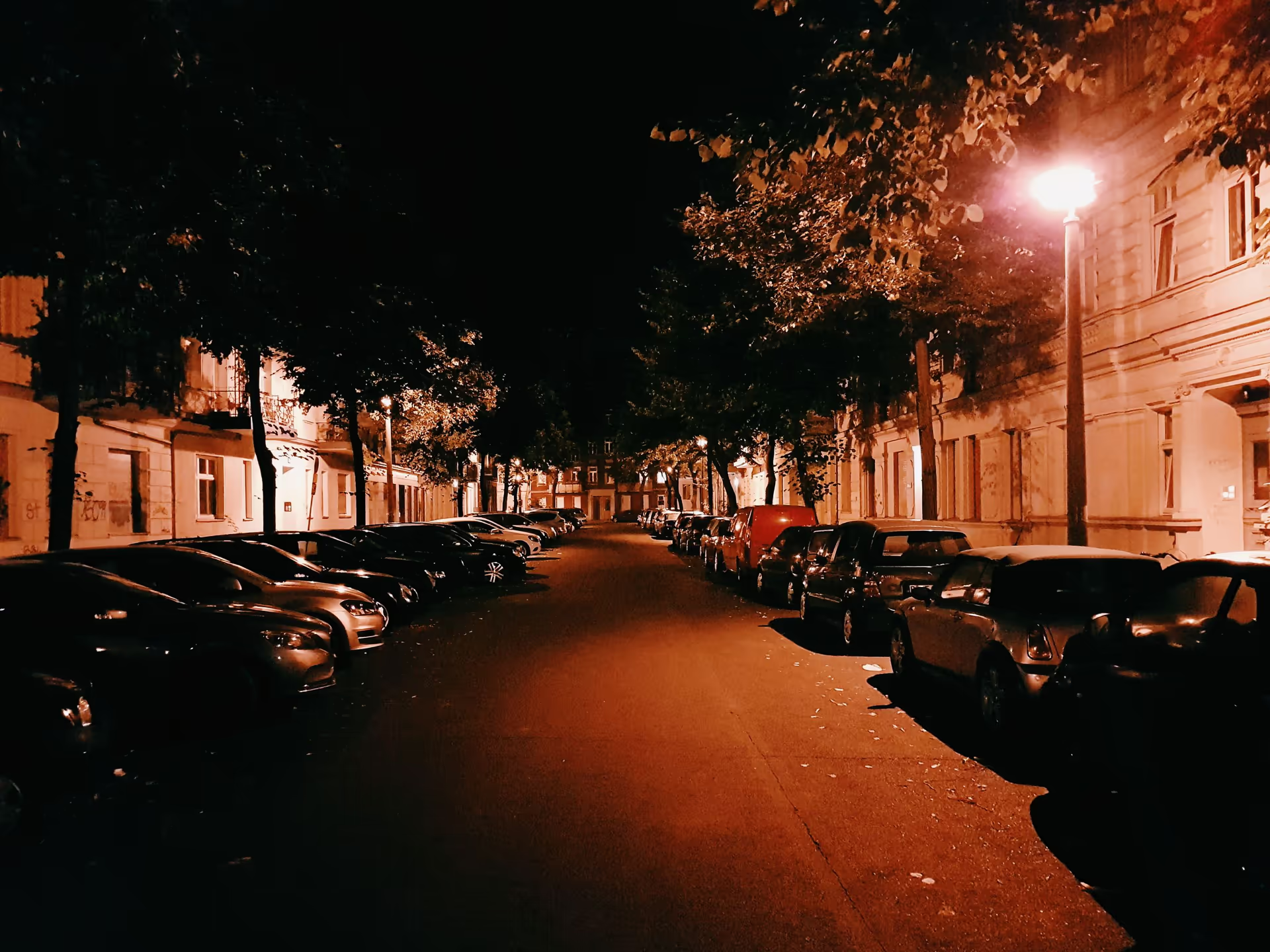
On private property you need the owner’s permission, and city code can limit what the owner allows. Eugene’s code requires a host lot to provide sanitary facilities, forbids charging, and lets the owner revoke permission at any time, after which you must leave [11]. Online lists of stores that allow overnight parking are crowdsourced; ask the store manager, or check the chain’s published policy, before you park.
If you are living in your car
If your car is where you sleep because you have nowhere else to stay, 211 is the national starting point: call 211, or use the local-211 finder on 211.org, for help with housing, food and emergencies. Every call is confidential [16]. Ask about safe-parking and host-lot programs as well; Eugene, Medford and Ashland write them into city code [11][17][18]. National forests and BLM land allow short-term camping within stay limits, not living there [2][5].
How to check the rule where you are
- National forest: the forest’s alerts page for a stay-limit or occupancy order, or the ranger district.
- BLM land: the field office for that area.
- Rest area: the state’s rule and the signs at the rest area.
- City street or public lot: the city’s municipal code. Search it for “camping”, “vehicle” and “habitation”, and read the definitions, since a camping ban can reach a car through how it defines a campsite. If the code is unclear, ask the city’s parking or police department.
- Private lot: the owner or manager, before you park.
To find public land for a short camping stay, Nomad Field Guide’s near-me tool lists the five nearest national forests and grasslands for a ZIP code.
Sources
- 36 CFR 261.58: Occupancy and useCode of Federal Regulations (GovInfo)
- 36 CFR 261.10: Occupancy and useCode of Federal Regulations (GovInfo)
- 36 CFR 261.2: DefinitionsCode of Federal Regulations (GovInfo)
- 43 CFR 8365.1-2: Occupancy and useCode of Federal Regulations (GovInfo)
- Camping on public landsBureau of Land Management
- 36 CFR 1.4: What terms do I need to know?Code of Federal Regulations (GovInfo)
- 36 CFR 2.10: Camping and food storageCode of Federal Regulations (GovInfo)
- Cal. Code Regs. tit. 21, § 2205: General (safety roadside rest areas)Legal Information Institute, Cornell Law School
- Rule 14-28.002: Public Use of Rest Areas and Welcome Centers, Truck Comfort Stations, and Wayside ParksFlorida Administrative Code
- Eugene Code 4.815: Prohibited CampingCity of Eugene
- Eugene Code 4.816: Permitted Overnight SleepingCity of Eugene
- Medford Municipal Code 5.257: Prohibited Camping, Lying, and SleepingCity of Medford
- Ashland Municipal Code 10.46.020: Camping prohibitedCity of Ashland
- City of Grants Pass v. Johnson, No. 23-175 (2024)Supreme Court of the United States
- A.R.S. 28-1381: Driving or actual physical control while under the influenceArizona State Legislature
- Call 211 for Essential Community ServicesUnited Way 211
- Medford Municipal Code 5.557: Overnight Sleeping in VehiclesCity of Medford
- Ashland Municipal Code 10.48.040: Overnight Sleeping in VehiclesCity of Ashland
- ORS 195.530: Noncamping use of public property by homeless individuals; attorney feesOregon Revised Statutes (OregonLaws)